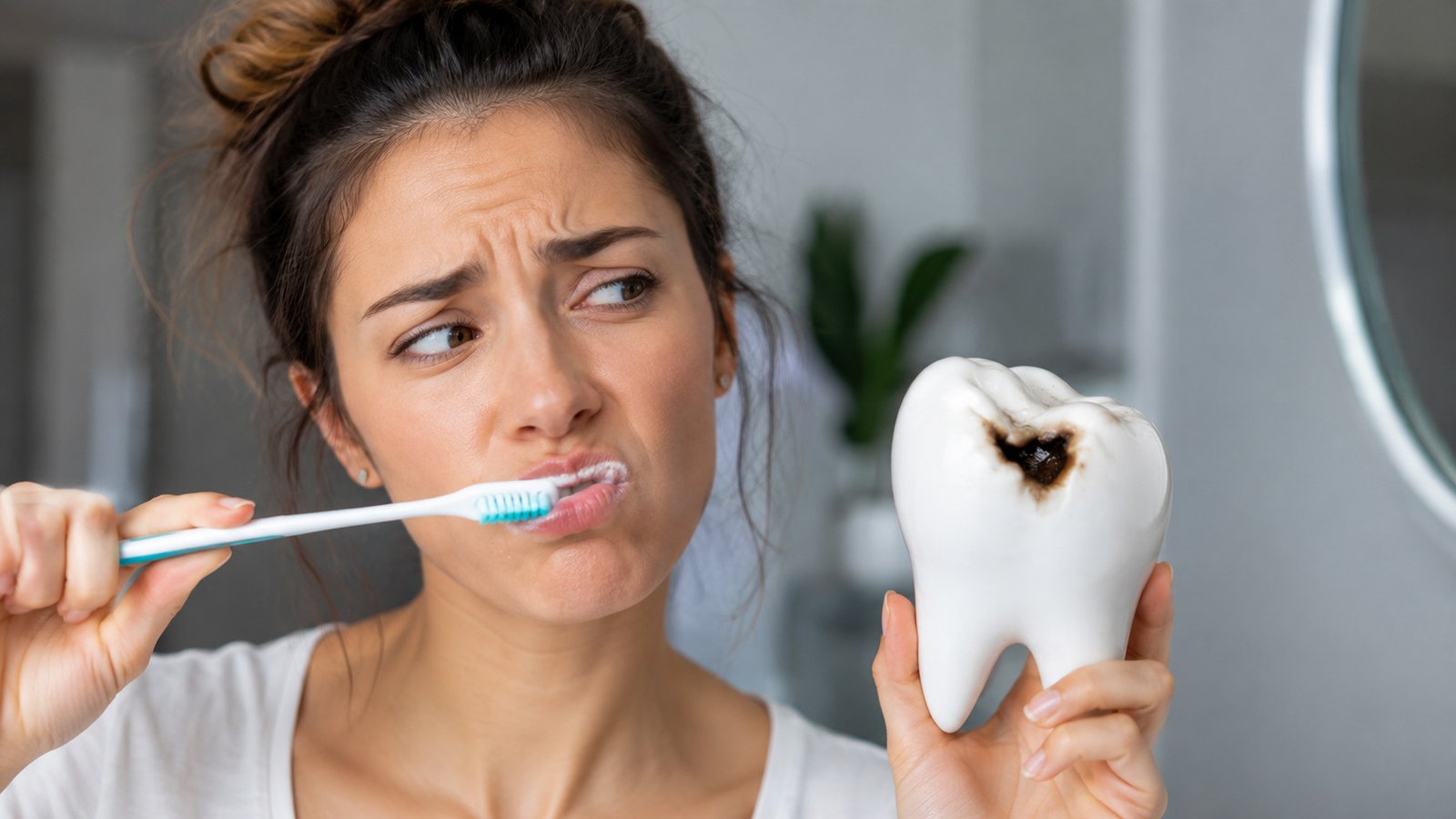
You brush your teeth every morning and brush again before bed. Maybe you even use a fancy electric toothbrush and a fluoride toothpaste that promises a healthier, brighter smile. Then, one day, your dentist says, “You have a cavity.”
It can feel unfair. After all, you have been brushing twice a day, the advice most of us have heard since childhood. But brushing twice daily is not a magic shield against tooth decay. It is one of the most important parts of preventing cavities, but what happens between those two brushing sessions matters too.
Tooth Decay, medically known as Dental Caries or simply Caries, is a gradual disease process involving bacteria, food, acids, saliva, fluoride, and the amount of time your teeth spend recovering between acid attacks. Your teeth are constantly losing and gaining minerals. When the balance repeatedly tips toward mineral loss, Caries can begin and gradually damage the tooth structure. A Cavity, meanwhile, is the hole or damaged area in a tooth that develops as the disease progresses.
That means someone can have a perfectly respectable-looking brushing routine and still have habits that quietly increase their cavity risk. The good news? Preventing cavities does not require becoming obsessed with your teeth. It requires understanding what actually causes cavities and making a few dental care habits work together.
What Actually Causes a Cavity?
A cavity does not appear simply because you didn’t brush enough. Your mouth contains hundreds of types of bacteria. Some are harmless, while some contribute to tooth decay. When certain bacteria encounter sugars and starches from food and drinks, they produce acids. Those acids attack the enamel, the hard outer surface of your teeth, and remove minerals from it.
Your saliva and fluoride work against this process. Saliva supplies minerals and helps neutralize acids. Fluoride strengthens enamel, reduces mineral loss and can help reverse early stages of tooth decay. So throughout the day, your teeth are essentially caught in a constant tug-of-war between mineral loss and repair.
If the attacks happen too frequently or mineral loss becomes greater than repair, the enamel eventually weakens enough for a cavity to form. And once a proper hole has formed in a tooth, brushing twice daily cannot simply brush it away. A dentist may need to restore the damaged tooth with a filling or another treatment.
Did you know?
Tooth enamel is the hardest substance in the human body.
Brushing Twice a Day Still Matters
Before we blame brushing for not doing everything, let’s make one thing very clear, brushing twice a day with fluoride toothpaste is essential.
The Indian Dental Association (IDA) recommends brushing at least twice daily for at least two minutes with fluoride toothpaste. Research and professional guidance support twice-daily brushing as an important part of reducing the risk of cavities and gum disease.
But there is an important detail people sometimes miss. It is not simply “brush twice.” It is,
Brush twice daily with fluoride toothpaste, thoroughly and consistently.
If someone spends 30 seconds aggressively scrubbing only the front surfaces of their teeth, they technically brushed. Their plaque, however, may not be impressed.
The goal is to clean all accessible tooth surfaces, including along the gum line and the chewing surfaces of the back teeth. Brushing should be gentle rather than a forceful back-and-forth scrubbing session. Think of brushing as the foundation of your cavity-prevention routine, not the entire building.
The Toothpaste and Toothbrush You Use Matters
Two people can brush for the same amount of time and still receive different levels of cavity protection depending on the toothpaste and toothbrush they use.
For preventing tooth decay, fluoride is the key ingredient to look for. Fluoride helps strengthen enamel and can help stop or reverse early tooth decay before a cavity becomes established. This is why choosing toothpaste based only on whitening claims, flavor, herbal ingredients, or how “fresh” your mouth feels can miss the more important question.
Does your toothpaste contain fluoride at an appropriate concentration that is approved by IDA?
A toothpaste can leave your mouth feeling spectacularly minty and still not be the best choice for cavity prevention if it does not provide adequate fluoride. Fresh breath is pleasant but strong enamel is more useful.
For people at particularly high risk of cavities, a qualified dentist may recommend additional fluoride treatments or products. Those decisions should be personalized rather than based on internet recommendations.
Your Brushing Technique Matters Too
Brush properly, not just regularly. Brushing twice a day only works well when you are actually cleaning the areas where plaque builds up. You do not need to scrub aggressively or make your toothbrush work overtime. The goal is gentle, thorough cleaning.
One of the most widely recommended and commonly taught techniques for adults is the Modified Bass Technique. It is particularly useful because it focuses on cleaning both the tooth surfaces and the area along the gum line, where plaque can easily accumulate.
To use the Modified Bass Technique:
- Hold a soft-bristled toothbrush at about a 45-degree angle toward the gum line, with the bristle tips gently directed into the area where the teeth and gums meet.
- Use small, gentle vibrating or circular movements rather than large, forceful back-and-forth scrubbing motions. This helps loosen plaque around the gum line and the shallow space between the tooth and gum.
- After cleaning a small area, gently sweep or roll the brush away from the gum line to clean the tooth surface. Move systematically across the outer, inner and chewing surfaces of your teeth, making sure you do not repeatedly miss the back teeth.
- For the inside surfaces of your front teeth, hold the toothbrush more vertically and use gentle up-and-down strokes with the tip of the brush, where the full brush head may be difficult to position.
The main benefit of the Modified Bass Technique is that it targets one of the most important areas for plaque control, the gum line. When performed gently and correctly, it can help remove plaque from the tooth surface and along the gingival margin without unnecessarily traumatizing the gums.
Brush for about two minutes, twice a day, using fluoride toothpaste. More pressure does not mean more cleaning. Brushing too hard can irritate the gums and contribute to gum recession or tooth wear. If your toothbrush looks like it has survived a fight with a lawn mower, you may be pressing too hard.
And one small habit makes a surprisingly big difference, do not rinse your mouth vigorously with water immediately after brushing. Spit out the excess toothpaste and allow the remaining fluoride to stay on your teeth for longer. If you use a fluoride mouthwash, use it at a different time rather than immediately after brushing so you do not wash away the fluoride left behind by your toothpaste.
A good brushing routine is therefore less about brushing harder and more about using the right technique, cleaning every surface and being consistent enough to let those habits actually work.
Your Teeth Care About How Often You Eat Or Drink
This is one of the most overlooked parts of cavity prevention. Imagine someone who has a sugary dessert once after lunch. Now compare that with someone who spends the entire afternoon repeatedly sipping sweetened tea, coffee, soft drinks, or sugary beverages. The total amount of sugar matters, but the frequency of exposure matters more.
Every time you consume sugars or fermentable carbohydrates, cavity-causing bacteria can produce acids. Your teeth then need time for saliva and fluoride to help restore lost minerals. Repeated eating and drinking, especially sugary or starchy foods and drinks, creates repeated acid attacks and gives the teeth less opportunity to recover.
This does not mean you have to declare war on dessert. It means that constantly grazing can be worse for your teeth than having a sweet food as part of a meal and then giving your mouth a break. And that innocent-looking habit of keeping a sugary soft drink beside your desk and taking a sip every few minutes for three hours? Your teeth may consider it a very long meeting with acids.
Snacking All Day Can Keep the Acid Attacks Going
Many people think, “I don’t eat much sugar.” But consider the entire day. Breakfast, a sweetened tea, a biscuit. Another tea, a packaged snack, a few bites of something while working. A soft drink, something sweet after dinner. Individually, these may not seem significant. Collectively, they can create frequent opportunities for acid production in the mouth.
The Indian Dental Association (IDA) recommends reducing both the amount and frequency of carbohydrate consumption for people at increased risk of cavities, particularly by limiting sugary snacks between meals.
You do not need to stop eating between meals altogether. But if you frequently snack, choosing tooth-friendly foods and reducing repeated sugary exposures can make a meaningful difference.
Sugary Drinks Are Particularly Easy to Underestimate
A chocolate bar is obvious but a sugary drink can be much sneakier. Soft drinks, sweetened tea and coffee, energy drinks, flavored beverages and some fruit drinks can expose teeth to sugars repeatedly, especially when consumed slowly over a long period.
And there is another problem, people often do not think of a “drink” as “eating.” But your teeth do not make that distinction. If a beverage contains fermentable carbohydrates, the bacteria in plaque can use them to produce acids. Frequent exposure can contribute to tooth decay.
Even a drink that sounds healthy is not automatically harmless for teeth. Fruit Juice, for example, can contain substantial amounts of naturally occurring sugar. Water is usually the simplest tooth-friendly drink between meals. But if your tongue is always greedy about sugary treats, don’t forget to rinse your mouth thoroughly with water before acid attack starts on your teeth.
Flossing Is Not Just for Removing Food
You brush your teeth, but your toothbrush cannot effectively clean every surface between tightly positioned teeth. That is where cleaning between the teeth becomes important.
Floss or another appropriate interdental cleaner can remove plaque from areas a toothbrush cannot adequately reach. And no, you do not have to wait until a piece of spinach becomes a public relations crisis before cleaning between your teeth.
The purpose is not merely to remove visible food. Flossing helps disrupt and remove plaque from difficult-to-reach areas, particularly between the teeth and near the gum line.
There is also something else happening in this area that most people never hear about, Gingival Crevicular Fluid, or GCF. This is a natural fluid found in the small space between the teeth and gums, known as the Gingival Crevice. GCF plays a role in the mouth’s natural defence system by helping transport immune cells and protective substances into this area. Its flow and composition can also change when the gums become inflamed.
That makes the gum line and the spaces between teeth more important than they may appear in the mirror. Plaque accumulating in these areas can irritate the gums and contribute to gum inflammation, while also leaving tooth surfaces between the teeth vulnerable to decay.
When flossing, gently guide the floss between the teeth and curve it around the side of each tooth in a C-shape rather than simply snapping it straight up and down. Move it gently below the gum line and clean both sides of the space before moving to the next tooth. The aim is to remove plaque without injuring the gums.
If flossing is difficult because of spacing, braces, dental work or dexterity issues, a qualified dentist or dental hygienist can recommend the most suitable interdental cleaning method.
Mouthwash Is Not a Replacement for Brushing
Mouthwash can be useful in certain situations, but it should not become the star of your oral-care routine. Swishing a liquid around your mouth does not replace physically removing plaque with a toothbrush and cleaning between the teeth.
Some mouth rinses contain fluoride and may provide additional cavity protection, while others are intended for different purposes. Whether you need one depends on your individual oral-health needs.
So if your routine is,
- Brush poorly
- Skip interdental cleaning
- Rinse with mouthwash
- Declare victory
Your teeth may not share your confidence.
For people with higher cavity risk, a dentist may recommend a particular fluoride rinse or other preventive dental treatment.
Saliva Is One of Your Teeth’s Natural Defenses
Your mouth has its own cavity-prevention system, and it works around the clock. Saliva helps wash away food particles, neutralize acids and provide minerals such as calcium and phosphate that help protect teeth. When saliva production is reduced, the risk of tooth decay can increase. This is why persistent dry mouth should not simply be dismissed as an inconvenience.
Certain medications, medical conditions, dehydration and other factors can contribute to dry mouth. If your mouth regularly feels unusually dry, especially if you are experiencing more cavities than usual, it is worth discussing with a healthcare professional or qualified dentist.
There is also a simple reason bedtime deserves special attention, saliva flow decreases during sleep. That makes sugary food or drinks after your nighttime brushing particularly unhelpful for your teeth.
What About Sugar-Free Gum?
Sugar-free chewing gum can be useful after meals, particularly because chewing stimulates saliva production. Some sugar-free gums contain Xylitol, which cannot be metabolized by cavity-causing bacteria in the same way as fermentable sugars. The ADA notes that sugar-free gum containing Xylitol can promote salivary flow and may support remineralization.
But gum is an addition to good oral hygiene, not a replacement for brushing and cleaning between teeth. And “sugar-free” does not automatically mean that every product is equally beneficial for teeth. Check the ingredients and consider the overall product rather than assuming the label tells the entire story.
Now, Let’s Debunk Some Common Dental Myths
Myth 1: If Your Teeth Don’t Hurt, They’re Fine
Unfortunately, cavities do not always send an early warning notification. Early tooth decay often produces no symptoms at all. As decay progresses, people may develop sensitivity or pain, but waiting for pain before visiting a dentist can mean waiting until the problem has become more advanced.
Regular dental examinations can identify early decay and other problems that you may not notice yourself. A small area of early mineral loss may sometimes be stopped or reversed with appropriate fluoride and preventive care. A fully formed cavity, however, is permanent damage that generally requires restoration.
So “nothing hurts” is not the same as “nothing is wrong.”
Myth 2: Harder Brushing Means Cleaner Teeth
It may sound logical. More pressure, more scrubbing, cleaner teeth. Except your teeth are not a dirty frying pan.
Aggressive brushing can damage the gums and contribute to gum recession or other problems. Good brushing is about technique and consistency, not trying to sand the enamel into submission.
Use a soft-bristled toothbrush, position it appropriately along the gum line and clean the surfaces gently and thoroughly. If your toothbrush looks like it has survived a fight with a lawn mower, you may be pressing too hard.
Myth 3: A Cavity Means You Don’t Brush Properly
Not necessarily. Cavity risk is influenced by several factors, including oral hygiene, diet, frequency of carbohydrate exposure, fluoride exposure, saliva, tooth anatomy and individual risk factors.
Some teeth naturally have deep pits and grooves where food and plaque can remain difficult to remove. Back teeth are particularly vulnerable because their chewing surfaces are uneven. Dental sealants can provide an additional protective barrier in appropriate patients, especially children and adolescents.
So someone can have a generally good oral-care routine and still develop decay. That is not a reason to give up. It is a reason to understand your individual risk.
Dental Visits Are Part of Prevention
A toothbrush cannot examine your teeth, take an X-ray, or identify a suspicious area between two teeth. And it certainly cannot tell you whether that “tiny dark spot” is something harmless or an early sign of tooth decay.
Dental examinations allow professionals to look for early tooth decay, gum problems and other conditions that may not be obvious at home. Professional cleaning can also remove plaque and hardened deposits that ordinary brushing cannot adequately remove.
How frequently you need dental visits depends on your oral health and risk level. There is no universal rule that every person must follow exactly the same interval. Your dentist can recommend an appropriate schedule.
Your Cavity Risk May Not Be the Same as Someone Else’s
This is important because oral-health advice is often presented as if one routine works identically for everybody. It doesn’t. Someone with excellent saliva flow, good fluoride exposure, low sugar frequency and healthy teeth may have a different cavity risk from someone with dry mouth, frequent snacking, exposed tooth roots, previous cavities or certain medications.
Even teeth with fillings can develop new decay around or underneath damaged areas, and exposed roots caused by gum recession can also be vulnerable to decay. That is why dentists sometimes recommend additional preventive measures for people at higher risk. Your oral-care routine should be good enough for your mouth, not simply copied from someone else’s bathroom shelf.
A Better Daily Routine
A cavity-prevention routine does not have to be complicated. A practical approach looks something like this.
- Morning: Brush thoroughly for about two minutes using fluoride toothpaste. Clean all accessible tooth surfaces rather than concentrating only on the front teeth.
- During the day: Drink water regularly and try to avoid constantly grazing on sugary or starchy foods and drinks. If you snack, be mindful of how frequently your teeth are being exposed to fermentable carbohydrates.
- After meals: If appropriate for you, cleaning between your teeth regularly can help remove plaque from areas your toothbrush cannot reach. Sugar-free chewing gum may also help stimulate saliva when brushing is not immediately practical.
- At night: Brush again with fluoride toothpaste. Make this the brushing session you do not casually skip because you are tired. And after brushing at night, avoid going back to sugary food or drinks. Your teeth deserve their overnight recovery period.
- Regularly: Visit a dentist for examinations and professional care according to your individual needs. If you repeatedly develop cavities despite following good habits, ask specifically about your cavity risk and whether you need additional fluoride or other preventive measures.
The Bigger Lesson About Cavities
The biggest misconception about cavities may be that they are simply the punishment for forgetting to brush. But the reality is more interesting.
- Your teeth are constantly undergoing a cycle of mineral loss and repair.
- Every sugary or starchy exposure can contribute to an acid attack.
- Saliva and fluoride help your teeth recover.
- Brushing removes plaque and delivers fluoride.
- Cleaning between teeth reaches areas brushing misses.
- Sensible eating habits reduce repeated attacks.
- Dental care helps identify problems before they become bigger ones.
None of these habits is a substitute for the others. That is why brushing twice a day is necessary, but not sufficient on its own.
Give Your Teeth More Than Two Minutes A Day
Taking care of your teeth is not about having a complicated shelf full of products or following every oral-health trend on social media. It is about getting the basics right and understanding why they matter.
Brush twice a day with fluoride toothpaste. Clean between your teeth. Be mindful of how often you expose your teeth to sugary and starchy foods and drinks. Give saliva and fluoride time to do their work. Pay attention to persistent dry mouth or other changes. And do not wait for tooth pain before getting professional dental care.
Most importantly, don’t think of cavity prevention as something that happens only in the bathroom, morning and night. Your teeth are working all day. Your habits are too. And sometimes, the difference between a healthy tooth and a future filling is not another expensive product, it is what you do during the many hours between those two toothbrush sessions.
Medical Disclaimer
This article is intended for general oral health education and awareness only. It does not replace professional dental advice, diagnosis, or treatment. If you have tooth pain, sensitivity, persistent oral problems, or concerns about cavities, consult a qualified dentist for personalized advice.