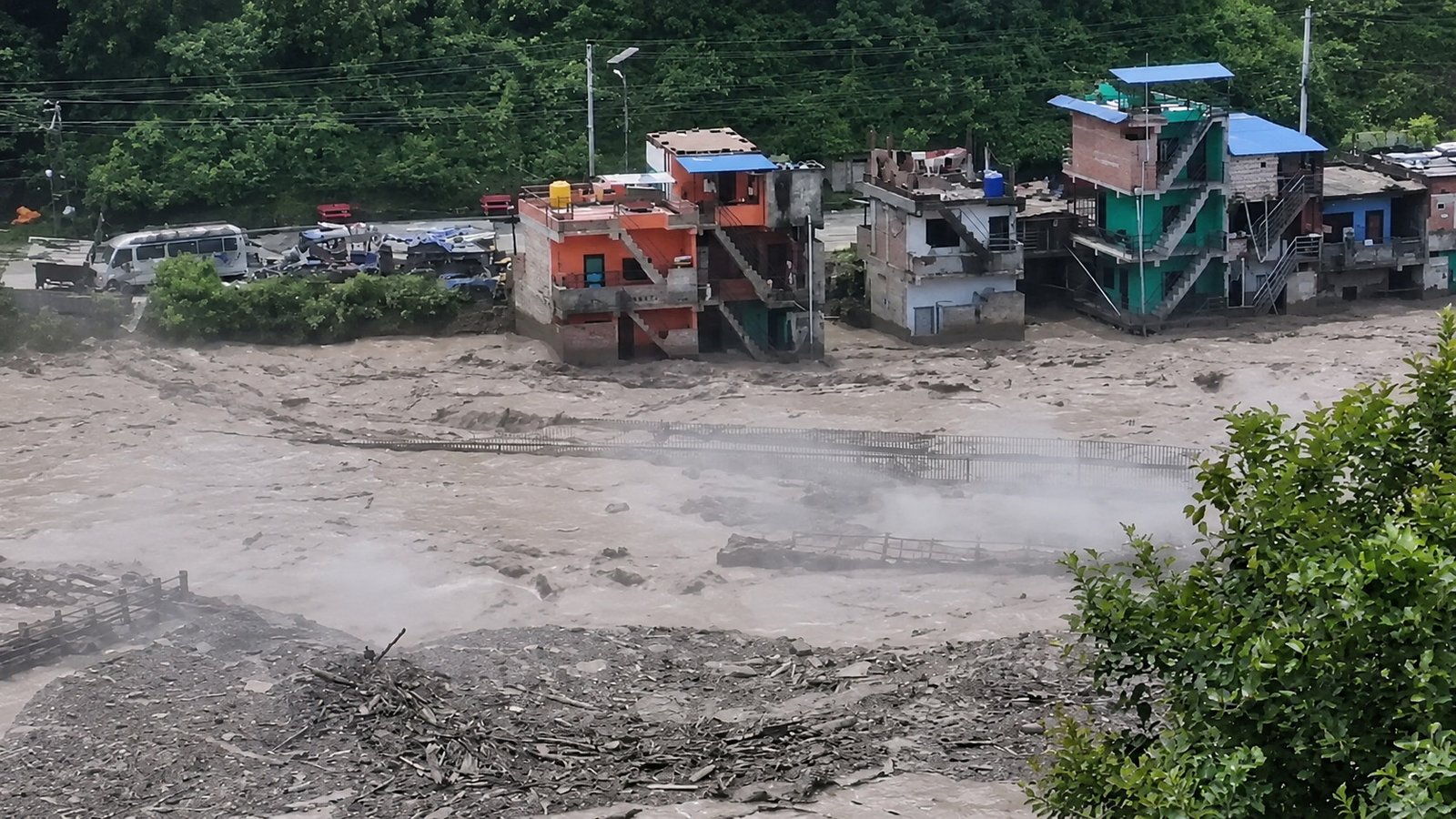
For generations, Nepal has lived with the monsoon. Heavy rainfall, swollen rivers and landslides have always been part of life in a country shaped by some of the world’s highest mountains. The monsoon season brings water that supports agriculture and communities but it also brings danger. What is changing is not simply that Nepal still floods. The nature of the risk itself is becoming more complicated.
In recent years, Nepal and the wider Hindu Kush Himalayan region have faced increasingly intense rainfall, destructive flash floods, landslides and hazards linked to rapidly changing glaciers and mountain environments. Scientists are also warning that a monsoon with less total rainfall does not necessarily mean a safer one. Longer dry periods followed by short bursts of extremely intense rain can be enough to trigger devastating floods and landslides.
The catastrophic flooding along the Nepal–Tibet border in August 2026 has brought that reality into sharp focus. The disaster was linked to a massive collapse involving rock, ice and debris in the high Himalayas, sending destructive flows through mountain valleys and causing severe downstream flooding. Scientists are still investigating the precise chain of events, but satellite observations and early scientific assessments show how multiple hazards in a warming mountain environment can combine into a single disaster.
Nepal’s floods, in other words, are no longer a story that can be understood simply as the monsoon arrived, and the rivers overflowed.
A Seasonal Problem Is Becoming A More Complex Risk
Nepal remains highly vulnerable to monsoon flooding for obvious geographical reasons. Its landscape rises dramatically from low-lying plains in the south to the Himalayan mountains in the north. Hundreds of rivers and streams descend through steep valleys, often carrying enormous volumes of water during periods of heavy rainfall. When intense rain falls on steep, fragile terrain, water can move quickly. That creates a particular danger, flash floods.
Unlike slower river flooding, flash floods can develop with little warning. A cloudburst, intense rainfall event, landslide or sudden release of water upstream can rapidly transform a relatively small mountain river into a destructive torrent. And rainfall is only one part of Nepal’s flood problem.
In the Himalayas, floods can also be connected to:
- Landslides blocking rivers and creating temporary lakes
- Sudden failure of natural dams
- Glacier and ice avalanches
- Glacial lake outburst floods
- Rapid snow and ice melt
- Debris flows carrying rocks, mud and water downstream
These hazards can interact with each other.
A landslide may block a river. Water can accumulate behind the blockage. If that natural dam fails, the released water can create a destructive flood downstream. In high mountain regions, unstable ice, glaciers, and warming permafrost can add another layer of risk. This is why scientists increasingly describe mountain flooding as a complex, cascading hazard rather than a single event with a single cause.
A major analysis of 1,015 floods across High Mountain Asia found that flood frequency has increased since 2000 and that rising temperatures are a key driver. The research also found an important change in timing. While many floods still occur during the monsoon, more events are happening outside the traditional monsoon period, making the risks less predictable.
That matters because communities can prepare for a familiar seasonal pattern more easily than for a threat that is becoming increasingly unpredictable.
More Rain Doesn’t Always Mean The Only Problem Is Rain
One of the biggest misconceptions about flooding is that disaster risk is determined simply by how much rain falls over an entire season. But extreme weather does not work that way. A season can receive below-average total rainfall and still produce deadly flooding if much of that rain arrives in a few intense events.
This is one of the concerns scientists have raised for the Hindu Kush Himalayan region in 2026. International Centre for Integrated Mountain Development (ICIMOD) warned that even where seasonal rainfall is expected to be below normal, communities could still face dangerous flash floods, landslides, and glacier-related hazards because of short periods of intense rainfall, combined with rising temperatures and changing weather patterns.
Imagine Two Different Monsoon Seasons
- In one, rain falls moderately and regularly over several weeks. The ground and rivers have time to absorb and carry much of the water.
- In another, there are long dry periods followed by a few hours of exceptionally intense rainfall.
The total amount of rain over the season could be similar or even lower in the second case but the immediate impact can be far more destructive.
On steep Himalayan terrain, that sudden concentration of water can overwhelm rivers, destabilise slopes and trigger landslides. This is the reason why the question is no longer simply, “How much will it rain this monsoon in Nepal?” It has become, “How intensely will it rain, where will it fall, and how quickly will the landscape respond?”
A Warming Himalaya Adds New Dangers
Climate change does not mean that every flood can automatically be blamed on global warming. Individual disasters usually have multiple immediate causes. Extreme rainfall, geological conditions, earthquakes, landslides, land use and infrastructure can all play a role.
But rising temperatures are changing the environment in which these disasters occur. The Himalayas contain one of the world’s largest concentrations of ice outside the polar regions. As temperatures rise, glaciers retreat and high-altitude environments change.
This can increase the risk of hazards that are particularly dangerous in mountain regions. Scientists are concerned about processes such as:
1. Glacier Retreat
As glaciers lose mass, they can leave behind unstable landscapes and expanding glacial lakes. Some of these lakes are naturally held back by loose deposits of rock and sediment rather than solid concrete-like structures. If a natural barrier fails, water can be released rapidly downstream.
2. Thawing Permafrost
At very high elevations, permanently frozen ground helps bind rocks and mountain slopes together. As temperatures rise, that frozen ground can weaken. The result can be greater instability in already fragile mountain terrain, increasing the risk of rockfalls and landslides. Scientists investigating the August 2026 Nepal–Tibet disaster have identified high-mountain slope and ice instability as important areas of investigation, while cautioning that the precise chain of causes is still being studied.
3. More Unstable Mountain Systems
The real danger is not one isolated process. A warming mountain environment can create conditions where several hazards are more likely to interact.
- Heavy rain can trigger a landslide.
- A landslide can block a river.
- Water can build up behind the blockage.
- The barrier can fail.
- And a flood can then travel far downstream, affecting communities that may never have experienced the original landslide.
That is what makes Himalayan disasters particularly difficult to predict and particularly dangerous.
Nepal’s Geography Turns Small Events Into Big Disasters
Nepal’s geography is spectacular, but it also creates extraordinary disaster risks. Mountain rivers often travel through narrow valleys. When large volumes of water and debris are forced through these confined spaces, the destructive power can increase dramatically.
A flood in the mountains is rarely just water. It can carry:
- Boulders
- Trees and Logs
- Soil
- Sediment
- Vehicles
- Parts of Buildings and Bridges
This turns a fast-moving flood into something closer to a moving wall of water and debris.
Infrastructure is also especially vulnerable. A damaged bridge can isolate entire communities. A blocked road can delay rescue teams. A destroyed hydropower facility can affect electricity supplies. In remote mountain regions, rebuilding even a short stretch of road can be difficult and expensive.
The August 2026 disaster demonstrated this vulnerability again, with roads, bridges, and critical infrastructure severely damaged across affected mountain areas. The consequences therefore continue long after the floodwaters recede.
Development Can Reduce Risk—or Make It Worse
Nepal cannot stop building roads, bridges, homes, and hydropower projects. Nor should it. Development is essential. But in a region where rivers, mountains, glaciers, and slopes are changing, where and how infrastructure is built matters enormously.
Poorly planned construction in flood-prone areas can increase exposure. Development that ignores landslide risk can put communities and infrastructure directly in the path of future disasters.
At the same time, modern infrastructure can also save lives when it is designed for the environment it exists in. This means Nepal and the wider Himalayan region need more than emergency response after disasters.
They need:
- Better flood-risk mapping
- Climate-resilient infrastructure
- Stronger land-use planning
- Improved monitoring of glaciers and glacial lakes
- Landslide monitoring in high-risk areas
- Reliable early-warning systems
- Clear evacuation plans for vulnerable communities
The goal should not be to pretend disasters can be completely eliminated. The goal is to ensure that a natural hazard does not automatically become a large-scale human catastrophe.
Early Warnings Matter, But People Must Know What To Do
Nepal has made important progress in flood forecasting and public warnings. The country’s Department of Hydrology and Meteorology operates flood forecasting and river-monitoring systems, while its monsoon response includes weather and flood bulletins and public alerts. During the 2024 monsoon season, Nepal issued 127 daily flood bulletins and sent millions of mass SMS alerts to the public.
But sending a warning is not always enough. A warning only becomes useful when people understand,
- What the warning means
- Whether they are personally at risk
- Where they should go
- How quickly they need to act
This is particularly important for flash floods, where minutes can matter.
Better technology can improve forecasting, but disaster preparedness also depends on local communication, public awareness and evacuation planning.
A community that receives a warning but has nowhere safe to go always remains vulnerable.
The Future Of Flooding In Nepal Will Not Look Like The Past
Nepal will continue to have monsoons. It will continue to have rivers that rise during heavy rainfall. Flooding itself is not new. What is changing is the context in which flooding happens.
Rising temperatures are altering glaciers and high-altitude landscapes. Rainfall patterns are becoming more erratic. Extreme events can concentrate enormous amounts of water into short periods. Landslides, glacier-related hazards, and floods can trigger each other. That means relying only on the idea of a predictable “flood season” is becoming increasingly risky.
Scientists studying High Mountain Asia have already found that floods are becoming more frequent and less predictable, including a growing number outside traditional monsoon periods. For Nepal, this creates a difficult reality. The country must prepare for the familiar dangers of the monsoon while also preparing for hazards that may not follow familiar patterns at all.
The Lesson Is Not That Floods Are New. The Lesson Is That The Risk Is Changing.
It would be inaccurate to say Nepal never faced serious floods before climate change. It has. Floods and landslides have always been part of life in the Himalayas. But today’s disasters are occurring in a rapidly changing environment, one with warmer temperatures, unstable mountain systems, changing rainfall patterns, and growing pressure on land and infrastructure.
That is why Nepal’s floods should no longer be viewed simply as an unfortunate event that arrives with the monsoon and disappears when the season ends. The floodwaters may recede. But the risk does not.
The challenge now is whether science, planning, and preparedness can change fast enough to meet a Himalayan landscape that already is.